The Postal Service Has a Choice: Evolve or Become a Relic
Amazon is pulling billions from USPS to build its own logistics empire. After 251 years and $118 billion in losses, the Postal Service faces a decision that the space industry already answered a decade ago.

Amazon just declared war on the clock. On March 17, the company expanded one hour and three hour delivery across hundreds of American cities, covering more than 90,000 products. Prime members pay $9.99 for one hour service and $4.99 for three hour windows. The move is a direct answer to Walmart, which now reaches 95% of US households with sub three hour fulfillment powered by its 4,700 store network.
This is not a shipping upgrade. This is a structural pivot. Amazon is building a parallel logistics economy that renders traditional delivery infrastructure obsolete. And the first casualty is already bleeding out.
The United States Postal Service is about to lose its largest customer.
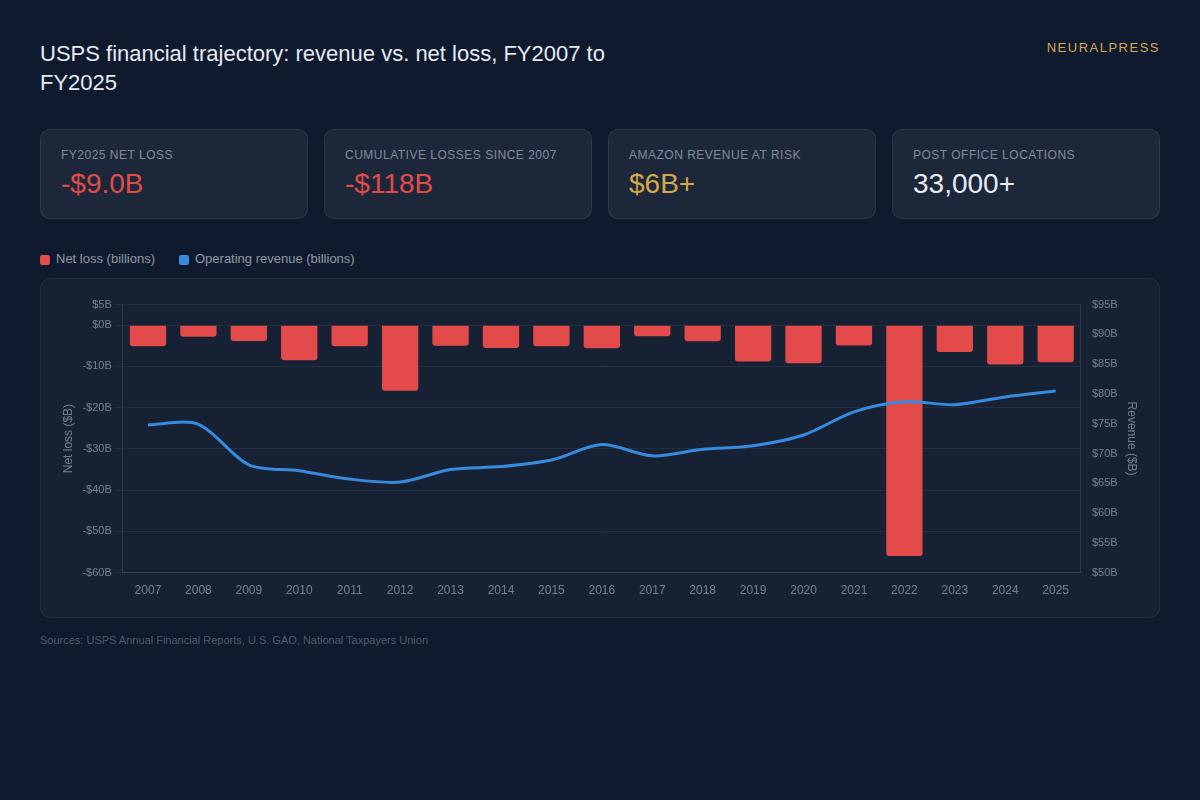
Reports from The Wall Street Journal and Reuters confirm that Amazon is planning to reduce its USPS package volume by at least two thirds before its contract expires in September 2026. The company has already been pulling back shipments, and the full reduction is expected by fall. Amazon currently accounts for more than $6 billion in annual USPS revenue, roughly 7.5% of total operating income.
USPS posted a $9 billion net loss in fiscal year 2025. Cumulative losses since 2007 now exceed $118 billion. First Class Mail volume has fallen by more than half over the past 15 years. The agency projects it could run out of cash as early as fiscal year 2026 if it made all required payments toward unfunded liabilities.
This is no longer a question of whether the Postal Service needs to change. The question is whether anyone in Washington has the operational courage to make the hard call.
An Institution Older Than the Nation Itself
The American postal system predates the Declaration of Independence. On July 26, 1775, the Second Continental Congress established a formal mail service and appointed Benjamin Franklin as the first Postmaster General. The system was not a bureaucratic afterthought. It was a strategic instrument of revolution. Underground correspondence networks had already allowed the Founders to communicate outside British surveillance, and formalizing a postal system gave the young republic its first real communications backbone.
The Constitution of 1787 explicitly granted Congress the power to establish post offices and postal roads. The Postal Service Act of 1792 went further, subsidizing newspaper delivery through the mail to promote civic engagement and political literacy. James Madison and his contemporaries understood that an informed electorate required a reliable, affordable, and censorship free information network. The postal system was that network.
For the next two centuries, the post office served as the connective tissue of American expansion. It followed the frontier westward. It enabled the mail order economy that built Sears and Montgomery Ward into household names. It helped rural communities participate in the same commercial and political systems as East Coast cities. When airmail launched in 1918, the Postal Service was an early adopter of aviation technology, providing the financial support that helped a fledgling airline industry survive.
In 1970, the Postal Reorganization Act transformed the old Post Office Department into the United States Postal Service, an independent, self financing entity within the executive branch. The intent was clear: operate like a business, cover your own costs, and continue delivering universal service to every address in the country.
That model worked for three decades. Mail volume peaked at more than 213 billion pieces in 2006. Then the internet happened, and the structural cracks became canyons.
The Numbers Tell the Story
The USPS operates more than 33,000 post office locations. It serves nearly 169 million addresses. It employs roughly 640,000 people, and labor costs account for almost 77% of total operating expenses.
In fiscal year 2025, total operating revenue reached $80.5 billion, a 1.2% increase over the prior year. That sounds positive until you see the other side of the ledger. Total operating expenses were nearly $89.8 billion. The controllable loss, which strips out items management cannot influence, was $2.7 billion, up from $1.8 billion the year before.
First Class Mail revenue increased slightly due to price hikes, but volume dropped by 2.2 billion pieces. Shipping and packages revenue grew 1%, but volume declined 5.7%. The Postal Service is raising prices on a shrinking customer base.
In Q1 of fiscal year 2026, the net loss was $1.3 billion. Operating revenue fell $264 million compared to the same quarter the previous year. Postmaster General David Steiner acknowledged the reality in plain language: the systemic annual revenue and cost imbalance far outweighs any appearance of financial progress.
The Government Accountability Office has kept USPS on its "High Risk" list since 2009. In December 2025, the GAO reported that the Postal Service's updated strategic plan contained no financial projections showing how its actions would restore sustainability. Without those projections, there are no targets, no accountability, and no credible path forward.
Meanwhile, the National Taxpayers Union noted that USPS has accumulated $118 billion in net losses since 2006 and warned that the agency is moving toward another taxpayer funded bailout similar to the $57 billion relief enacted in 2022.
Organizational Physics Says Scale Down the Mass
There is a principle in organizational dynamics that applies directly to what the Postal Service is facing. Large institutions accumulate mass over time. That mass takes the form of physical infrastructure, workforce headcount, legacy processes, union agreements, regulatory constraints, and cultural inertia. The greater the mass, the more energy is required to change direction. And at some point, the mass itself becomes the primary obstacle to survival.
USPS has enormous mass. More than 33,000 physical locations. A six day delivery mandate for an economy that increasingly communicates digitally. Collective bargaining agreements covering roughly 80% of the workforce. Congressional oversight that limits pricing flexibility and operational autonomy. Unfunded pension and retiree health liabilities that consume billions annually.
The organizational physics are simple. You cannot accelerate a body of that size through a market that is moving faster every quarter. Amazon just compressed delivery windows to 60 minutes. Walmart can reach nearly the entire country in under three hours. USPS is still debating whether to hold a reverse auction to replace its largest customer.
The only viable response to excessive organizational mass is to reduce it. Not through incremental trimming, but through deliberate structural contraction.
That means closing thousands of redundant post office locations. Many of the 33,000 sites sit within close proximity to another post office or serve communities where foot traffic no longer justifies the overhead. Cluster mailbox systems and digital alternatives can handle the volume. The real estate alone, if monetized through sale or lease, could fund modernization initiatives.
It means reducing the delivery mandate from six days to four or five, aligning service frequency with actual demand rather than a 1970s era legislative framework.
It means addressing the labor cost structure. When compensation and benefits consume 77 cents of every operating dollar, there is no cost optimization strategy that avoids the workforce. Staggered attrition, voluntary retirement incentives, and a gradual shift toward private sector labor standards are the options. None of them are painless.
But the alternative is a slow organizational death funded by taxpayers who are already carrying the weight of an $118 billion loss record.
The Space Industry Already Proved the Model
There is a precedent for what happens when government loosens its grip on a mission critical capability and allows private capital to compete.
For decades, NASA was the sole operator of American spaceflight. Launches were expensive, infrequent, and dependent on legacy contractors like Boeing and Lockheed Martin. Development cycles stretched across decades. The Space Launch System, a government managed program, burned through years and billions in cost overruns. Budget constraints, bureaucratic processes, and risk aversion kept innovation at a crawl.
Then the government opened the door to private enterprise.
SpaceX entered the market in the early 2000s with a fundamentally different approach: move fast, iterate aggressively, accept calculated risk, and fund development through private capital. The company built the Falcon 9 and Cargo Dragon spacecraft to supply the International Space Station. NASA conducted its own internal study and found that developing the same capability through traditional government contracting would have cost four to ten times more than what SpaceX delivered.
The results extended beyond cost savings. SpaceX developed reusable launch vehicles, a technology that government agencies had previously resisted. Launch costs dropped dramatically. Frequency increased. The private capital markets responded, and an entire commercial space ecosystem emerged. Blue Origin, Rocket Lab, Firefly Aerospace, and dozens of others followed. The global space economy is now projected to exceed $1 trillion by the 2040s.
The key insight is not that government is inherently incompetent. It is that government operated monopolies, constrained by political oversight, budget cycles, and institutional risk aversion, cannot innovate at the pace required by modern markets. Private capital brings talent access, operational speed, and competitive pressure that no congressional appropriation can replicate.
The same logic applies to mail and package delivery. USPS operates as a hybrid entity: part government service, part regulated monopoly, part commercial enterprise. That identity crisis is the root of its dysfunction. It is expected to compete with FedEx, UPS, and now Amazon while operating under constraints that none of those competitors face.
The Case for Privatization
The argument for privatizing USPS is not ideological. It is operational.
A private operator, or a consortium of private operators under a regulated framework, would bring several structural advantages that USPS cannot access in its current form.
Capital allocation would follow market logic rather than political logic. Investment decisions would be driven by return on capital, customer demand, and competitive positioning rather than congressional horse trading and election year optics.
Technology adoption would accelerate. The private sector has already demonstrated its ability to deploy AI driven logistics, autonomous delivery systems, drone networks, and predictive inventory placement at a pace that government agencies cannot match. Amazon restructured its entire North American logistics network into eight regional clusters powered by machine learning. Walmart is retrofitting distribution centers with autonomous systems. USPS is still running a network designed for a mail volume peak that occurred 20 years ago.
Workforce flexibility would improve. Private operators can adjust headcount, compensation structures, and job roles in response to market conditions. USPS is locked into collective bargaining agreements and congressional mandates that prevent the kind of rapid organizational restructuring the market demands.
The universal service obligation, the requirement to deliver to every address regardless of geography, could be preserved through a regulatory charter similar to what exists in telecommunications and utilities. Privatization does not mean abandoning rural America. It means creating a structure where rural delivery is funded transparently through regulatory mechanisms rather than hidden in a $9 billion annual loss.
Several countries have already moved in this direction. The United Kingdom privatized Royal Mail in 2013. Germany's Deutsche Post went public in 2000 and now operates one of the most profitable logistics networks in the world through its DHL subsidiary. Japan privatized its postal system in stages beginning in 2007. Each model is different, but the pattern is consistent: private capital and market discipline produce better outcomes than government operation.
What USPS Could Become
If the political will existed to restructure the Postal Service, here is what the next decade could look like.
Scenario one: managed contraction. USPS reduces its physical footprint by 40% to 50%, closing redundant locations and consolidating operations into regional hubs. Delivery frequency drops to four or five days per week. The workforce is reduced through attrition and voluntary incentives. The agency focuses exclusively on letter mail, government correspondence, and election infrastructure. Package delivery is ceded to the private market. USPS survives as a smaller, leaner government service with a narrower mandate.
Scenario two: public private partnership. USPS retains its regulatory charter and universal service obligation but contracts last mile delivery to private operators on a regional basis. The reverse auction concept that Postmaster General Steiner has proposed could evolve into something more permanent. Regional carriers, retailers with store networks, and technology driven logistics companies bid for delivery zones. USPS becomes the regulatory backbone and address database while private operators handle the physical delivery. This is essentially the NASA and SpaceX model applied to mail.
Scenario three: full privatization. Congress authorizes the conversion of USPS into a publicly traded corporation or sells the operation to a private consortium. The universal service obligation is preserved through regulation, similar to how telecom companies are required to provide service in rural areas. The new entity has access to private capital markets, can set its own pricing, and operates under standard corporate governance. Real estate assets are monetized. Technology investment accelerates. The brand, which remains the most trusted federal service according to polling, becomes a commercial asset rather than a political football.
Each scenario has tradeoffs. Managed contraction is the most politically achievable but does nothing to solve the structural revenue problem. A public private partnership preserves the government role but introduces coordination complexity. Full privatization delivers the most transformative outcomes but faces the steepest political resistance.
The one scenario that does not work is the status quo.
The Clock Is Running
Amazon is not waiting for USPS to figure itself out. The company is investing $4 billion to build out rural delivery coverage that triples its existing network by the end of 2026. It is testing 30 minute delivery in select markets. Its logistics infrastructure now includes more than 30,000 delivery vehicles and a growing fleet of autonomous systems.
Walmart has 4,700 stores within 10 miles of 90% of the US population and is converting those locations into automated fulfillment nodes.
The private logistics market is moving at the speed of capital and technology. USPS is moving at the speed of Congress.
For 251 years, the American postal system has adapted to every major economic and technological shift this country has experienced. Stagecoach to railroad. Railroad to airmail. Airmail to interstate highway. Each transition required institutional courage and a willingness to let go of the old model before the new one was fully formed.
This is one of those moments. The question is not whether USPS will change. It is whether the change will be chosen deliberately or imposed by the market. The space industry answered that question a decade ago. The postal system is overdue for the same reckoning.
Sources: Reuters, Axios, USPS Newsroom, U.S. GAO, National Taxpayers Union, Smithsonian Magazine, USPS Postal Facts, Logistics Management, PYMNTS